
Bathroom Fittings Prices in South Africa: A Realistic Budget

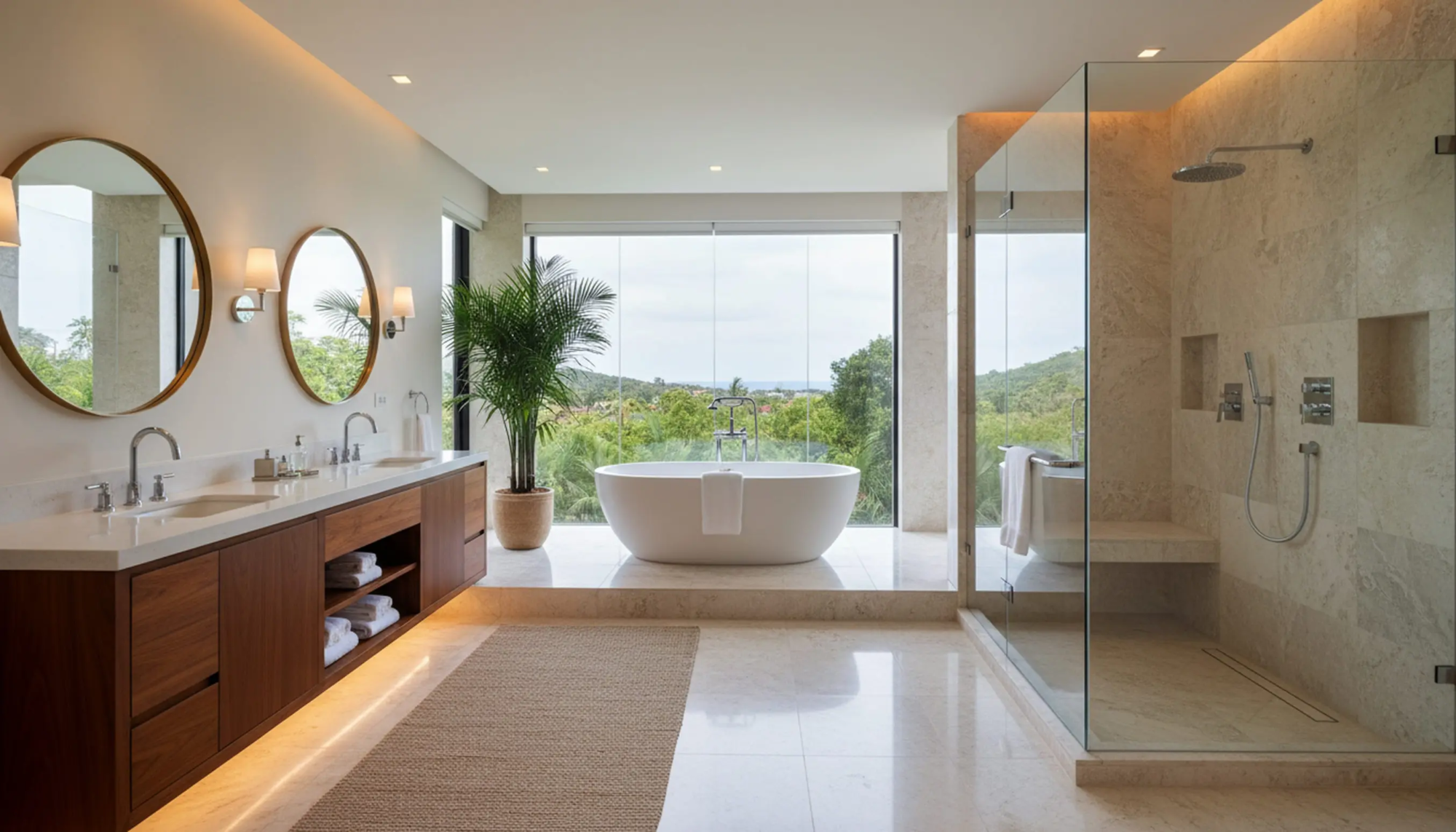
A bathroom is the smallest room in the house and the one most likely to blow the renovation budget. Not because the fittings are expensive on their own, but because there are eleven of them and nobody counts the waste pipes.
Here’s what bathroom fittings cost in South Africa in 2026, what separates a budget suite from a mid-range one, and the costs that sit outside the fittings bill.
Bathroom fitting prices in 2026
The ranges below are typical 2026 retail for standard sanitaryware and brassware, excluding VAT. They cover the whole spread from builder-grade to comfortable mid-range, and they move with the rand, because most of this product is imported.
| Item | Typical price range | Notes |
|---|---|---|
| Close-coupled toilet suite | R1,800 to R6,500 | Budget to mid range, dual flush |
| Wall-hung toilet with frame | R4,500 to R12,000 | Includes carrier frame and flush plate |
| Basin, 500 to 600mm | R400 to R2,200 | Pedestal or counter-top |
| Vanity unit with basin | R2,200 to R9,000 | 600mm to 1,200mm, single or double |
| Bath, standard acrylic | R2,500 to R9,500 | 1.5m to 1.7m, with or without panel |
| Shower tray and enclosure | R2,800 to R14,000 | Tray, glass and door |
| Basin mixer tap | R350 to R2,800 | Washer to ceramic cartridge |
| Shower mixer | R700 to R4,500 | Exposed or concealed |
| Toilet seat and cistern internals | R180 to R900 | First parts to fail, worth upgrading |
Add it up and a straightforward family bathroom lands somewhere between R12,000 and R22,000 in fittings. A second bathroom kitted to the same standard is usually cheaper per room, because you’re buying the second basin and toilet on the same order.
What separates a budget suite from a mid-range one
What separates them sits inside the tap and behind the wall, not in the look.
- The cartridges. A cheap tap uses washers that wear, drip and chew through water. A mid-range tap uses ceramic cartridges that last years. The tap costs more and the plumber costs less, and over five years the mid-range one usually wins.
- Brass content. Chrome plating over solid brass survives. Chrome over a lighter alloy pits and flakes, especially in a coastal town. The weight difference is felt in the hand before you even fit it.
- Water consumption. Dual flush cisterns at 6 and 3 litres are the norm now. Older single-flush cisterns use 9 to 11 litres a flush, and that shows up on a municipal bill across a family of five.
- Spares availability. A no-name imported suite with no local spares backup becomes a full replacement when a cistern valve gives up. That’s the risk with the cheapest thing on the shelf.
- Glaze quality. Better sanitaryware holds its surface, which means it stains less and cleans easier. Cheap glaze scratches, and a scratched toilet is a toilet that always looks dirty.
You can feel the difference in the bathroom fittings range by picking two taps up and comparing the weight in your hand.
What the fittings don’t include
This is where bathroom budgets actually go wrong.
Waterproofing is the big one. A shower needs a proper membrane under the tiles, and a wet room needs it everywhere. That’s a specialist step with a specialist price, and skipping it is how you end up replacing a ceiling two years later.
Then there’s the plumbing. Moving a toilet or a basin means moving a waste pipe, and waste falls downhill. A small shift is a small job. Moving a toilet across the room means cutting into the slab or building a raised floor, and both cost more than the toilet did.
Labour follows. A plumber’s day rate, a tiler’s day rate, and an electrician if the lights and the extractor fan are moving. On a full strip-out, labour frequently comes to more than the fittings.
And the small stuff adds up fast. Wastes, traps, flexible connectors, silicone, screws, isolation valves, a new toilet seat, a shower curtain rail or a glass panel. Budget R1,500 to R3,000 for the bits that never make the shopping list.
South African realities that affect the spec
Water pressure varies enormously between a municipal line in Sandton and a rural stand on a pressure pump. Gravity-fed systems and low-pressure geysers behave differently to a mains-pressure house, and a shower mixer built for mains pressure will disappoint on a gravity system. Check what your property actually runs before you buy the fancy rain shower head.
Water restrictions are a permanent feature of Gauteng summers now, so anything that reduces consumption quietly pays for itself. A dual flush cistern and a low-flow shower head cost very little more and cut a real percentage off the municipal account.
Load-shedding is a plumbing issue, oddly enough. Geyser elements and pressure pumps need power, and a household on a failing borehole pump during a long outage has bigger problems than a dripping tap. If the bathroom is part of a broader upgrade, an inverter for the pump and the geyser is worth pricing at the same time.
And the climate matters at the coast. Salt air eats chrome fittings faster than anything inland, so coastal installations need better-quality brassware and more attention to the external components. A tap that lasts fifteen years in Pretoria may look tired in five years in Durban.
Buying the suite without wasting money
Spend on the things that are hard to replace and save on the things that are easy. Toilets, mixers and shower fittings should come from a brand with local spares. Vanity units, mirrors and accessories can be cheaper, because when they fail you unbolt them and hang a new one.
Buy the whole room at once. Fittings ordered together come from the same production batch, match on colour and finish, and land on one delivery. Buying the basin in March and the toilet in June is how the whites end up two shades apart.
Ask about the warranty terms before you pay, and ask how long spares take to arrive. That question separates a shop that stocks from a shop that dropships.
Our home and interior range covers sanitaryware, taps and bathroom accessories, and the live prices sit on that category page. The full product range shows what the branches carry, and if you’re fitting out several units at once, our wholesale pricing is worth a call.
Bring your measurements, or a photo of the existing layout, to the Wynberg branch in Sandton and we’ll help you match fittings to the space. Prefer to send it through? Use the contact page. New to Build Africa SA? Everything starts at our home page.
One cost people forget is the floor. Tiles, adhesive and grout for a bathroom typically add R2,000 to R6,000 to a renovation, and that’s before the waterproofing. Our tile adhesive and grout guide works through those quantities and prices.
Frequently asked questions
How much does a full bathroom cost in South Africa in 2026?
A straightforward family bathroom lands around R12,000 to R22,000 in fittings for a toilet, basin, bath or shower, and taps. Add waterproofing, plumbing labour, tiling and about R1,500 to R3,000 of sundries, and a full renovation typically runs well past the fittings cost alone.
How much does a toilet cost in South Africa?
A close-coupled dual flush suite runs roughly R1,800 to R6,500 depending on brand and glaze quality. A wall-hung toilet with its carrier frame and flush plate is R4,500 to R12,000, and the frame has to be built into the wall during the renovation.
Why are bathroom fittings so expensive in South Africa?
Most sanitaryware and brassware is imported, so the price tracks the rand and freight costs. Chrome over solid brass costs more than chrome over a lighter alloy, and ceramic cartridges cost more than washers, and both differences are worth paying for in a bathroom.
Should I buy a cheap tap or a branded one?
Buy branded for anything that sees daily use. A cheap tap with washers drips within a couple of years and wastes water, and if the brand has no local spares you replace the whole tap. Vanity units and accessories are safer places to save.
Does a new bathroom need waterproofing?
Yes, and a shower or wet room needs a proper membrane under the tiles. Waterproofing isn’t optional and it isn’t covered by the tiles. Skipping it is the most expensive shortcut in a bathroom, because the damage shows up in the room below.
How much extra should I budget for labour and sundries?
On a full strip-out and refit, plumbing and tiling labour often exceeds the fittings cost, and sundries such as wastes, traps, connectors and silicone run R1,500 to R3,000. Budget labour and fittings as two separate lines rather than one.