
What a Tiling Job Really Costs Beyond the Tiles

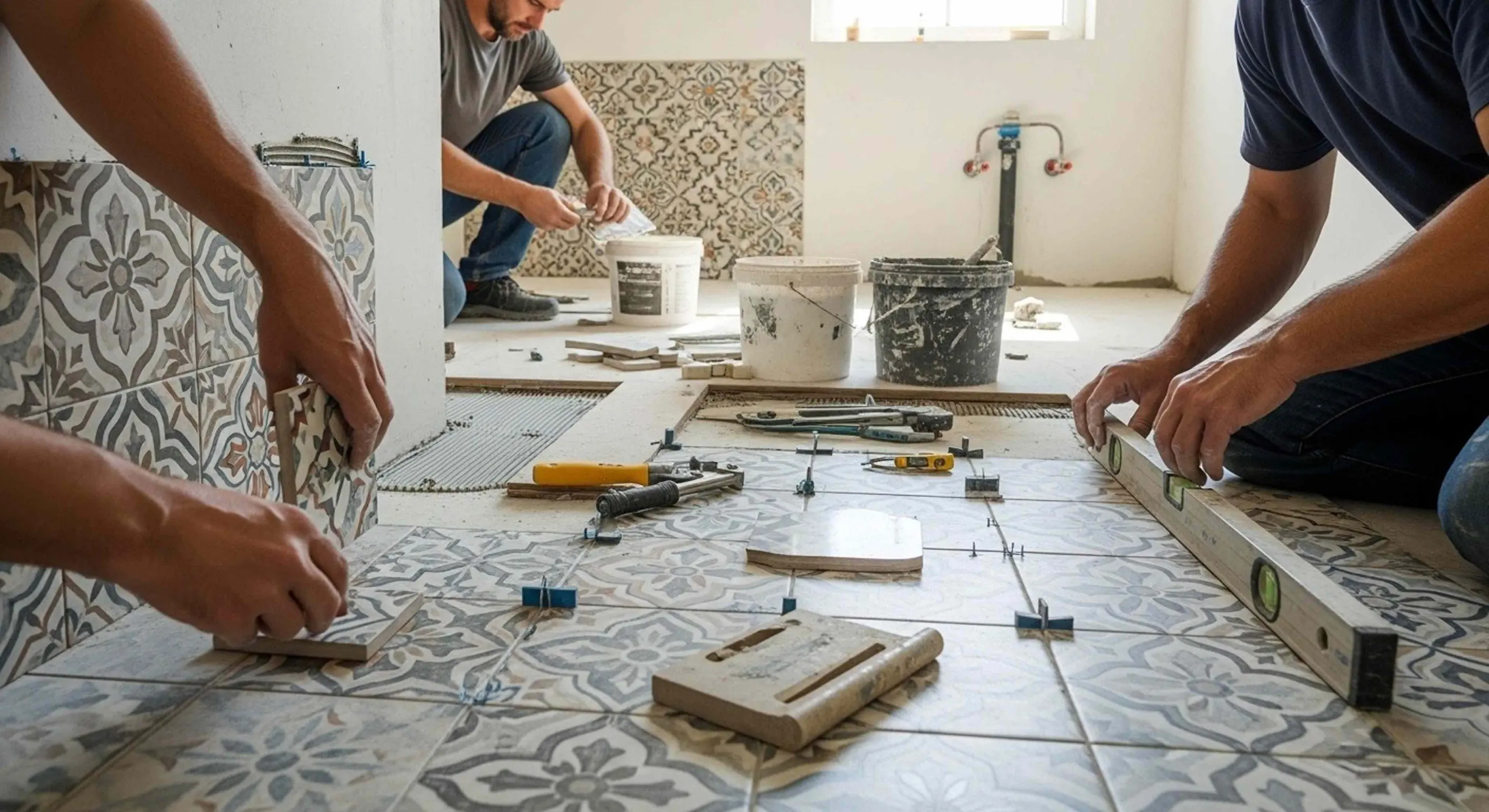
Almost every tiling budget we see is built on the tile price per square metre and almost nothing else. Then the job starts, and the consumables add up to a number that nobody planned for.
Here is what those extras actually cost, so the budget survives contact with the job.
The full material stack
A tiled surface is tile plus a set of consumables, and the consumables are not optional:
| Item | What it does | Typical price |
|---|---|---|
| Tile adhesive (20kg) | Bonds tile to substrate – different grades for floor and wall | R44.99 – R64.90 |
| Tile grout (1kg) | Fills joints; also seals the edge against water | R38.49 |
| Tile spacers | Sets consistent joint width | R27.49 – R32.99 per pack |
| Roof tile (per unit) | Roofing, not floor tiling – a separate job entirely | R11.99 |
Note the last row carefully, because it causes real confusion: roof tiles and floor tiles are different products with different pricing structures. A roof tile is priced per unit; a floor or wall tile is priced per square metre or per box. Quoting one against the other is comparing nothing.
What each consumable actually costs per square metre
The unit prices above only become useful once you translate them to area:
- Adhesive is the largest consumable line on most jobs, and consumption depends on trowel size and how level the substrate is. A badly levelled floor can double adhesive use – which is why levelling compound is a cost, not a luxury.
- Grout consumption depends on tile size and joint width. Small tiles mean more joints, and more joints mean more grout and more labour.
- Spacers are cheap per pack, but you need the right size for the tile format, and thin spacers on a large-format tile rarely give a good result.
- Trims, edge strips and waterproofing for wet areas are frequently forgotten until the tiler asks for them.
Where the money goes on a real job
The breakdown we see most often on a bathroom or kitchen floor:
- Tiles – the visible line, and the one everybody prices first
- Adhesive and grout – easy to underestimate, and bought by the bag rather than by the room
- Preparation – levelling, screeding, removing the old surface. This is where budgets break, because it is invisible work
- Labour – charged per square metre or per day, and much higher for small tiles than for large ones
- Wastage – cutting and breakage. Ten per cent is a realistic allowance; more on complex layouts
- Delivery – charged per trip, so it pays to buy the whole job in one go
How to compare tile prices properly
Two tiles at the same price per square metre can end up costing very different amounts to install:
| Tile format | Adhesive use | Grout and joints | Labour |
|---|---|---|---|
| Large format | Higher per square metre, needs a level substrate | Fewer joints, less grout | Faster to lay, but harder to handle and cut |
| Small format | Moderate | Many more joints, more grout | Slower, more cutting |
| Mosaic / patterned | Moderate to low | Highest joint count | Slowest, most skill-dependent |
The practical conclusion: ask what the installation cost per square metre will be for the tile you are considering, not just what the tile costs. Large format tiles look expensive on the shelf and are sometimes cheaper to install; small tiles look cheap and are often not, once grout and labour are counted.
Where you can genuinely save
- Buy the whole job at once. Tile batches vary slightly, and a second delivery costs another trip charge.
- Choose a standard tile size over a boutique format when the room does not demand the special one.
- Level the substrate properly first. It costs money and saves more adhesive and labour downstream.
- Use the correct adhesive grade. Wall adhesive on a floor is a false economy that fails.
- Keep spares from the same batch. Matching a tile in three years is far harder than storing a box.
Getting real numbers
Tiles, adhesives, grout, spacers and tiling tools are all stocked at our Wynberg, Sandton branch, so you can price the job in one place rather than running between suppliers. Current pricing for the full range is on the category page: browse our tiles, adhesives and tiling consumables with live prices.
Tell us the room dimensions and the tile you have in mind, and we can put a complete materials list together – including the extras people usually discover they need on the second trip.
Choosing a tile that suits the room
The tile that looks best in the showroom is not always the one that performs best where you are putting it. Four properties decide whether a tile is suitable:
| Property | Why it matters | Where it counts most |
|---|---|---|
| Water absorption | Determines whether the tile belongs on a wall, a floor or outdoors | Bathrooms, showers, patios |
| Slip resistance | Rated surface texture; a polished floor becomes dangerous wet | Bathrooms, kitchens, pool surrounds, ramps |
| Frost and thermal resistance | Affects outdoor durability and movement | Outdoor areas, sunny north-facing spaces |
| Abrasion resistance | How the surface wears under foot traffic | Entrances, corridors, commercial floors |
The practical rules that come out of that: porcelain is denser and less porous than standard ceramic, which makes it the safer default for floors and wet areas. Polished tiles are a poor choice for a floor that gets wet – a matte or textured finish is both safer and easier to live with. And a tile rated for walls should not be laid on a floor simply because it matches.
Laying pattern changes the quantity
Pattern is another cost driver that rarely appears in a budget:
- Straight lay uses the least tile and the least cutting.
- Diagonal or diamond increases cutting along every edge, which increases both labour and wastage.
- Herringbone and similar patterns use more material and demand a higher standard of workmanship to look correct.
If the look you want needs a pattern, price it with the extra wastage and labour included. If you are working to a tight budget, a rectified large-format tile in a straight lay delivers a clean modern finish with far less cutting – and often a lower total cost than the “cheaper” patterned option.
Frequently asked questions
How much tile adhesive do I need per square metre?
It depends on the tile and the trowel size, and it rises significantly if the substrate is uneven. As a rule the adhesive is a meaningful line in the budget, not a rounding error, and substrate levelling reduces total consumption.
Is grout expensive?
Grout itself is inexpensive per kilogram, but small tiles with many joints consume far more of it than large-format tiles. The grout cost is driven by joint count rather than by floor area alone.
Are roof tiles priced the same way as floor tiles?
No. Roof tiles are priced per unit – currently around R11.99 – while floor and wall tiles are priced per square metre or per box. They are different products for different jobs and cannot be compared on price directly.
How much wastage should I allow for tiles?
Ten per cent is a realistic allowance for a straightforward room. Increase it for diagonal layouts, herringbone patterns, small rooms with many cuts, or anywhere the offcuts cannot be reused.